Out for the Count
I haven't posted for the last several weeks because I've been recuperating from my third cardiac ablation. This last procedure seems to finally have returned my heart to regular sinus rhythm, though only time will tell.
Since about 2000 I've suffered from an irregular heartbeat, first in the form of atrial fibrillation, and then, after my first two ablations, a persistent heart flutter. My downfall this time around was not the procedure itself, which went as smoothly as a "non-invasive" procedure could go. This time around I was given a "bridge" anti-coagulant to which I had a bad reaction. Evidently, when blood seeps into a muscle it acts as an irritant and leaves what looks like a bruise in its wake. My experience of this, which required a visit to the emergency room on the evening of July 4th, was as if my entire right thigh muscle was locked in an unrelenting "charley-horse."
At any rate, I haven't done much over the last week other than down pain killers and watch television. In-between reruns of Star Trek Voyager and The Dog Whisperer, I have had some random thoughts which I thought I'd share here:
Newtonian vs. Einsteinian Media Biases:
Harold Innis, a founding father of Media Ecology, used a Newtonian metaphor to argue that the nature of a civilization is determined by the characteristics of its dominant communication medium. Innis believed that a medium contained either a time bias or a space bias.
Cultures that carved their stories into stones, like the early Sumarians or Egyptians, were time-binders and tended to be conservative in terms of change and stable in terms of social hierarchy. Stones were hard to carry any distance, but lasted a long time. Carved stone is an example of a time-binding medium.
Papyrus is an example of a space-binding medium, which the Romans used to command a vast empire. Papyrus could be carried easily and allowed the Romans to send orders over great distances, but it didn't last very long, and was subject to destruction by fire and other forces. Cultures that used more portable materials were able to command vast empires, but lacked the stability of stone or clay cultures.
The Internet, upon which rich media technology is dependent, may be the first instance in human history of a medium which binds both space and time equally. Therefore, it may be time to abandon Innis' Newtonian metaphor for an Einsteinian metaphor. New electronic media, especially the Internet, bind both time and space. The ubiquity of the World Wide Web is counterbalanced by the permanence of server storage and retrieval, a combination I have called the “Memory Well.” Combined with cheap and ubiquitous recording devices, sites like YouTube and blogs like Crooks and Liars permit the permanent storage and and nearly instantaneous retrieval from anywhere in the world of any cultural event, from political panders to sneezing pandas.
A society which based its communication structure on the Internet would have to change its notion of what knowledge is and how to communicate that knowledge to its citizens. Just as the handheld calculator freed students from the need to memorize the multiplication tables, the Internet Memory Well may force a reassessment of what needs to be taught and how to teach it.
A One-Horse Race
Remember when John McCain's bid for the White House was declared dead and buried? How is it that it was resurrected?
Is there anyone besides me who thinks that the McCain run for the Presidency is a farce? Has any candidate for President committed so many factual gaffs, surrounded himself with so many counterproductive advisers or seemed so out of touch with the true concerns of the electorate?
Even George W. Bush in his dry-drunk prime could run a coordinated political campaign. John McCain can't remember that Czechoslovakia is no longer a country, or that Sunnis are different than Shias. He can't even remember what he was for before he was against it. He admits to economic ignorance and technological backwardness. He perpetuates positions on Iraq and civil liberties that have been proven non-starters for years.
I think that the Republicans know that 2008 is not going to be their year, big time, and so they have fielded a non-candidate, letting poor McCain fulfill his lifelong dream to run towards a goal that no Republican can win.
The question is, what neo-conservative wheels are turning while we are distracted by the continuing political circus? Are the major trauma of the home mortgage crisis or the oil price fiasco evidence of neo-con last ditch efforts to cash in before January 20, 2009?
Showing posts with label atrial fibrillation. Show all posts
Showing posts with label atrial fibrillation. Show all posts
Tuesday, July 15, 2008


Monday, November 26, 2007
My Blogging Milestone (Part 5): What Dick Cheney and I have in Common
Updated below
In conjunction of the Associated Press’s report that Dick Cheney has been diagnosed with atrial fibrillation, here is my slightly updated May 27 post concerning my own AF:
If your heart is pounding, it may not necessarily be love. Or in the case of Dick Cheney, oil.
I was at dinner with my family in 2001 when my heart started beating rapidly. No, it wasn't because we were having meat loaf for dinner. It turned out that I was experiencing an episode of atrial fibrillation, which is defined by the American Heart Association as follows:
I relate this information, not to solicit sympathy (although I am accepting any and all donations), but rather as an introduction to a piece I wrote concerning the heart as a metaphor that I presented at the 2005 Media Ecology Association Convention, and a version of which I have posted at The Heart of the Matter.
As I was lying on my back after my first ablation (you must remain still for eight hours after the procedure), I began to think about the heart, an organ which most of us take for granted. That didn't help me get to sleep, so I began to think about the heart as a metaphor. It occurred to me that the heart, as related in popular culture, performs functions other than the pumping of blood.
The metaphor of the heart is not about the circulation of blood or the regulation of physical health. As portrayed in popular culture, the heart is the site of emotions, of certain deep thoughts that correspond to the true beliefs of an individual. The heart is also portrayed as a source of wisdom that can be tapped if we pay attention to it.
This did succeed in making me drowsy, but I was able to begin a line of thought about the reason why conceptual metaphors, like that of the heart, persist in our culture, despite changes in dominant media forms, social structures and languages.
Heart Songs: When Janis Joplin (1999) sang “take another little piece of my heart” , she wasn’t discussing cardiac ablation. The references to the metaphoric heart are the rule rather than the exception in most music, popular, classical or traditional. Singers admonish us not to “break my heart,” or to have pity on an “achy, breaky heart.” Even Bob Dylan, who generally avoided the romantic traditionalism of music lyrics in his use of metaphor could tell us “I gave her my heart, but she wanted my soul.” (1967)
The Poetry of the Heart: Nor was Emily Dickenson concerned with anatomy when she wrote:
Imagine if we substituted the word “brain” for the “heart” in Dickenson’s poem. How would we react to the poem if we change that one word?
Heart Literature: To the protagonist of Antoine de Saint Exupery’s classic, The Little Prince, the heart was a perceiving organ, not a biological pump:
In Pride and Prejudice, Jane Austin’s Elizabeth Bennet rejects a marriage proposal with a heartfelt reply:
Heart Movies: A brief scene from the highly successful Lord of the Rings illuminates the portrayal of the metaphor of the heart in many films and on television:
In each of these examples, the metaphoric heart stands in for aspects of cognition that we resist assigning to the head. One would expect that in our computer saturated era, the heart would lose traction as a site of cognition.
For any non-metaphoric heart that is in AF for more than 48 hours, an electrical shock will often bring back a regular beat. If not, there are a variety of drugs (none of which worked for me). Another option is a cardiac ablation which involves snaking a thin wire from a vein in the groin up to the heart and applying a cauterizing jolt of electricity to the offending nerve.
With his history of heart ailments, it is not surprising that Cheney would develop atrial fibrillation. While not life-threatening itself, the irregular heartbeat can be unpleasant, and as the AP reports:
UPDATE: It has also been noted that this irregular heartbeat is not the only type of a fib that Cheney has been involved in.
In conjunction of the Associated Press’s report that Dick Cheney has been diagnosed with atrial fibrillation, here is my slightly updated May 27 post concerning my own AF:
If your heart is pounding, it may not necessarily be love. Or in the case of Dick Cheney, oil.
I was at dinner with my family in 2001 when my heart started beating rapidly. No, it wasn't because we were having meat loaf for dinner. It turned out that I was experiencing an episode of atrial fibrillation, which is defined by the American Heart Association as follows:
Atrial fibrillation is a disorder found in about 2.2 million Americans. During atrial fibrillation, the heart's two small upper chambers (the atria) quiver instead of beating effectively. Blood isn't pumped completely out of them, so it may pool and clot. If a piece of a blood clot in the atria leaves the heart and becomes lodged in an artery in the brain, a stroke results. About 15 percent of strokes occur in people with atrial fibrillation."Atrial fibrillation, or "afib", is more likely to occur in the elderly, or in patients whose heart has been compromised by illness or surgery. I don't fit any of the regular profiles, and as my cardiologist said, other than the afib, I have the heart of an eighteen-year-old (the bad news is he wants it back!) Since that initial episode, I have taken a variety of medications in an attempt to control my afib episodes and I have undergone two cardiac ablations:
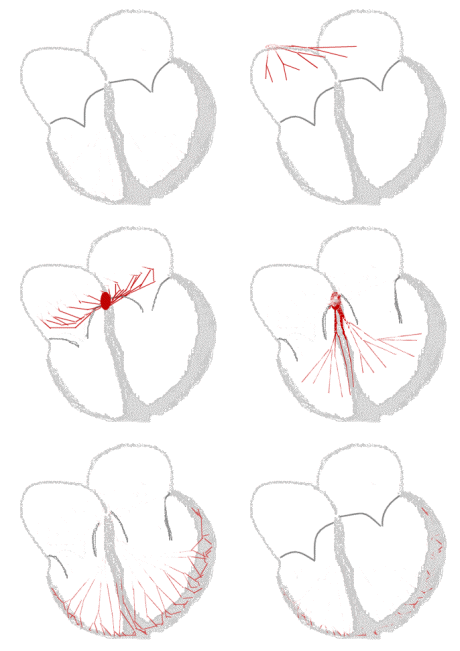
Radiofrequency ablation may be effective in some patients when medications don't work. In this procedure, thin and flexible tubes are introduced through a blood vessel and directed to the heart muscle. Then a burst of radiofrequency energy is delivered to destroy tissue that triggers abnormal electrical signals or to block abnormal electrical pathways.After my second ablation failed to completely curtail my heart's fibrillation, my perplexed cardiologist suggested that I have a "mutant" heart. I'm still waiting for the super powers. As these two "non-invasive" procedures have only been partly successful, I remain on beta blockers and blood thinners to control the worst of the symptoms.
I relate this information, not to solicit sympathy (although I am accepting any and all donations), but rather as an introduction to a piece I wrote concerning the heart as a metaphor that I presented at the 2005 Media Ecology Association Convention, and a version of which I have posted at The Heart of the Matter.
As I was lying on my back after my first ablation (you must remain still for eight hours after the procedure), I began to think about the heart, an organ which most of us take for granted. That didn't help me get to sleep, so I began to think about the heart as a metaphor. It occurred to me that the heart, as related in popular culture, performs functions other than the pumping of blood.
The metaphor of the heart is not about the circulation of blood or the regulation of physical health. As portrayed in popular culture, the heart is the site of emotions, of certain deep thoughts that correspond to the true beliefs of an individual. The heart is also portrayed as a source of wisdom that can be tapped if we pay attention to it.
This did succeed in making me drowsy, but I was able to begin a line of thought about the reason why conceptual metaphors, like that of the heart, persist in our culture, despite changes in dominant media forms, social structures and languages.
Heart Songs: When Janis Joplin (1999) sang “take another little piece of my heart” , she wasn’t discussing cardiac ablation. The references to the metaphoric heart are the rule rather than the exception in most music, popular, classical or traditional. Singers admonish us not to “break my heart,” or to have pity on an “achy, breaky heart.” Even Bob Dylan, who generally avoided the romantic traditionalism of music lyrics in his use of metaphor could tell us “I gave her my heart, but she wanted my soul.” (1967)
The Poetry of the Heart: Nor was Emily Dickenson concerned with anatomy when she wrote:

The heart asks pleasure first
And then, excuse from pain;
And then, those little anodynes
That deaden suffering.
Imagine if we substituted the word “brain” for the “heart” in Dickenson’s poem. How would we react to the poem if we change that one word?
Heart Literature: To the protagonist of Antoine de Saint Exupery’s classic, The Little Prince, the heart was a perceiving organ, not a biological pump:
"One sees clearly only with the heart. Anything essential is invisible to the eyes."How would we react if the quote was: “One sees clearly only with the brain. Anything essential is invisible to the eyes.” This one change makes the quotation seem ridiculous. Clearly the metaphoric associations for the brain differ from those of the heart.
In Pride and Prejudice, Jane Austin’s Elizabeth Bennet rejects a marriage proposal with a heartfelt reply:
"Do not consider me now as an elegant female intending to plague you, but as a rational creature speaking the truth from her heart."Elizabeth also uses her heart as an input device:
"(she) found the interest of the subject increase, and listened with all her heart; but the delicacy of it prevented further inquiry."References to the heart as a metaphor can be found almost everywhere you look in literature, regardless of the period, the language or the genre surveyed.
Heart Movies: A brief scene from the highly successful Lord of the Rings illuminates the portrayal of the metaphor of the heart in many films and on television:
Aragorn: No news of FrodoWhat if Aragorn had asked Gandalf: “What does your brain tell you?” It just doesn’t sound right.
Gandalf: No word. Nothing.
Aragorn: We have time. Every day Frodo moves closer to Mordor.
Gandalf: Do we know that?
Aragorn: What does your heart tell you?
Gandalf: (meaningful pause) That Frodo’s alive. Yes. Yes, he’s alive.
(The Lord of the Rings: The Return of the King, 2004)
In each of these examples, the metaphoric heart stands in for aspects of cognition that we resist assigning to the head. One would expect that in our computer saturated era, the heart would lose traction as a site of cognition.
For any non-metaphoric heart that is in AF for more than 48 hours, an electrical shock will often bring back a regular beat. If not, there are a variety of drugs (none of which worked for me). Another option is a cardiac ablation which involves snaking a thin wire from a vein in the groin up to the heart and applying a cauterizing jolt of electricity to the offending nerve.
With his history of heart ailments, it is not surprising that Cheney would develop atrial fibrillation. While not life-threatening itself, the irregular heartbeat can be unpleasant, and as the AP reports:
...if the irregular heartbeat continues, it eventually can cause a life-threatening complication -- the formation of blood clots that can shoot to the brain and cause a stroke.What's unusual about Dick Cheney's AF is that I thought he was already on a defibrillator, which usually would control any AF symptoms. It will be interesting to see, as the story develops, if the White House doctors explain how Cheney's defibbed heart can go into afib.
UPDATE: It has also been noted that this irregular heartbeat is not the only type of a fib that Cheney has been involved in.
Sunday, May 27, 2007
The Heart of the Matter
If your heart is pounding, it may not necessarily be love.
I was at dinner with my family in 2001 when my heart started beating rapidly. No, it wasn't because we were having meat loaf for dinner. It turned out that I was experiencing an episode of atrial fibrillation, which is defined by the American Heart Association as follows:
Atrial fibrillation, or "afib", is more likely to occur in the elderly, or in patients whose heart has been compromised by illness or surgery. I don't fit any of the regular profiles, and as my cardiologist said, other than the afib, I have the heart of an eighteen-year-old (the bad news is he wants it back!)
Since that initial episode, I have taken a variety of medications in an attempt to control my afib episodes and I have undergone two cardiac ablations:
I relate this information, not to solicit sympathy (although I am accepting any and all donations), but rather as an introduction to a piece I wrote concerning the heart as a metaphor that I presented at the 2005 Media Ecology Association Convention, and a version of which I have posted at a new blog, The Heart of the Matter.
As I was lying on my back after my first ablation (you must remain still for eight hours after the procedure), I began to think about the heart, an organ which most of us take for granted. That didn't help me get to sleep, so I began to think about the heart as a metaphor. It occurred to me that the heart, as related in popular culture, performs functions other than the pumping of blood. To quote from my paper:
I was at dinner with my family in 2001 when my heart started beating rapidly. No, it wasn't because we were having meat loaf for dinner. It turned out that I was experiencing an episode of atrial fibrillation, which is defined by the American Heart Association as follows:
Atrial fibrillation is a disorder found in about 2.2 million Americans. During atrial fibrillation, the heart's two small upper chambers (the atria) quiver instead of beating effectively. Blood isn't pumped completely out of them, so it may pool and clot. If a piece of a blood clot in the atria leaves the heart and becomes lodged in an artery in the brain, a stroke results. About 15 percent of strokes occur in people with atrial fibrillation.
Atrial fibrillation, or "afib", is more likely to occur in the elderly, or in patients whose heart has been compromised by illness or surgery. I don't fit any of the regular profiles, and as my cardiologist said, other than the afib, I have the heart of an eighteen-year-old (the bad news is he wants it back!)
Since that initial episode, I have taken a variety of medications in an attempt to control my afib episodes and I have undergone two cardiac ablations:
Radiofrequency ablation may be effective in some patients when medications don't work. In this procedure, thin and flexible tubes are introduced through a blood vessel and directed to the heart muscle. Then a burst of radiofrequency energy is delivered to destroy tissue that triggers abnormal electrical signals or to block abnormal electrical pathways.After my second ablation failed to completely curtail my heart's fibrillation, my perplexed cardiologist suggested that I have a "mutant" heart. I'm waiting for the super powers. As these two "non-invasive" procedures have only been partly successful, I remain on beta blockers and blood thinners to control the worst of the symptoms.
I relate this information, not to solicit sympathy (although I am accepting any and all donations), but rather as an introduction to a piece I wrote concerning the heart as a metaphor that I presented at the 2005 Media Ecology Association Convention, and a version of which I have posted at a new blog, The Heart of the Matter.
As I was lying on my back after my first ablation (you must remain still for eight hours after the procedure), I began to think about the heart, an organ which most of us take for granted. That didn't help me get to sleep, so I began to think about the heart as a metaphor. It occurred to me that the heart, as related in popular culture, performs functions other than the pumping of blood. To quote from my paper:
The metaphor of the heart is not about the circulation of blood or the regulation of physical health. As portrayed in popular culture, the heart is the site of emotions, of certain deep thoughts that correspond to the true beliefs of an individual. The heart is also portrayed as a source of wisdom that can be tapped if we pay attention to it.This did succeed in making me drowsy, but I was able to begin a line of thought about the reason why conceptual metaphors, like that of the heart, persist in our culture, despite changes in dominant media forms, social structures and languages. The results can be found at the link above, and I welcome comments.
Subscribe to:
Posts (Atom)